
FOR PRACTITIONERS

Specialized hair and scalp assessment for referred patients

FHI provides detailed hair-specific assessment, biologically informed interpretation, longitudinal monitoring, and structured feedback to support diagnostic, treatment, referral, and follow-up decisions.

Led by Peter R. Feldman, PhD (Medicine), Certified Trichologist and Evidence-Based Hair Fellow.

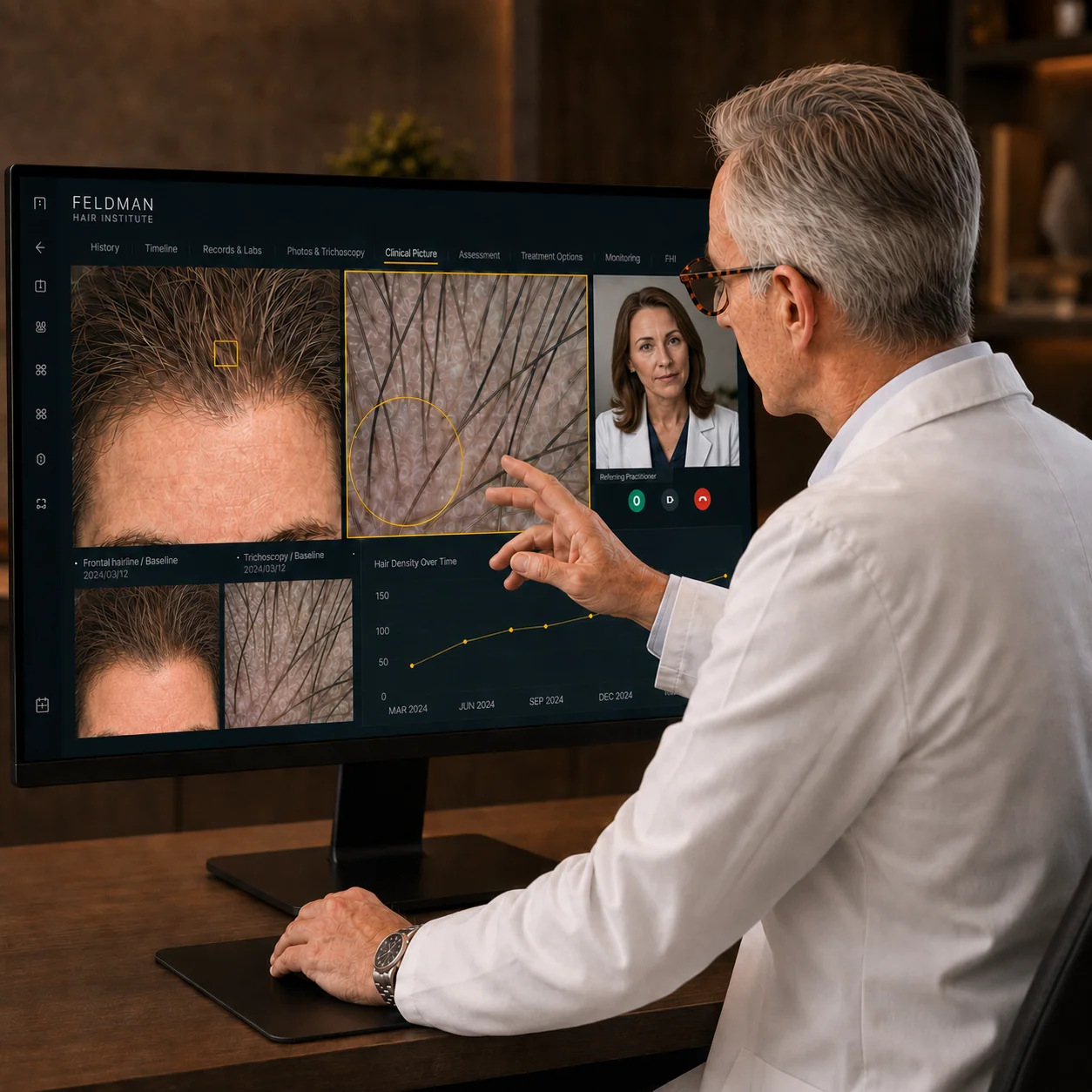
Peter Feldman reviewing de-identified hair and scalp findings with a referring practitioner by video

Where FHI fits

The referring practitioner identifies the clinical question and remains central to the patient’s care. FHI adds the time-intensive hair-specific assessment and measurement layer: timeline reconstruction, distribution analysis, clinical photography, trichoscopy, treatment-response review, integration of existing records, and defined monitoring markers.

With patient consent, relevant findings, unresolved questions, and follow-up priorities are returned to the referring practitioner.

When referral to FHI is useful

Diagnostic and pattern clarification

Persistent or recurring hair loss with an unclear trajectory. Ongoing visible change despite normal or non-explanatory laboratory findings. Discordance among the clinical distribution, photography, trichoscopy, biopsy, or prior assessment. Competing diagnoses, mimickers, or overlapping alopecias.

Treatment-decision and response support

Baseline assessment before treatment. Response that is difficult to interpret or poorly documented. Relapse, partial recovery, or treatment benefit that varies across scalp regions. Patients considering prescriptions, PRP, laser, product programs, exosomes, transplantation, or treatment escalation.

Specific presentations

Alopecia areata activity, relapse, response, recovery, and monitoring. Scarring or inflammatory-pattern cases requiring documentation and longitudinal assessment. Drug-induced, post-illness, congenital, inherited, syndromic, chemotherapy-, radiation-, fungal-, or breakage-related presentations.

Practice support

Structured history, photography, laboratory, biopsy-report, and treatment review. Patient-facing explanation and a defined monitoring framework. Objective comparison during treatment follow-up. A concise practitioner-facing summary and continued feedback in referred cases.

The referral and feedback pathway

The practitioner defines the clinical question. FHI completes the hair-specific assessment and interpretation, returns relevant findings, and can continue objective monitoring while the practitioner remains responsible for clinical decisions and treatment.

The referral and feedback pathway
  1. Practitioner question and records
  2. Patient intake and consent
  3. FHI hair and scalp assessment
  4. Biologically informed interpretation
  5. Findings returned
  6. Practitioner decision
  7. FHI monitoring

What to send / What FHI returns

What to send

  • The clinical question or reason for referral.
  • The current diagnosis, differential, or clinical impression, where available.
  • Relevant treatment history and response.
  • Photographs, laboratory results, biopsy or pathology reports, trichoscopy, and specialist notes, where available.
  • The aspect to be characterized, documented, or monitored.
  • Practitioner contact details for return communication.

What FHI returns

  • A summary of the referral question and relevant history.
  • Distribution, clinical photography, trichoscopy, and other assessment findings.
  • Biologically informed interpretation of the current activity and trajectory.
  • Concordant, discordant, and unresolved findings.
  • Defined monitoring markers and a suggested follow-up interval.
  • Follow-up information on progression, stabilization, relapse, recovery, or treatment response where monitoring continues.

Bring FHI into your clinic

Offer your patients access to an independent, in-depth hair-loss assessment within your clinic.

FHI performs the assessment and provides findings with an evidence-informed plan for practitioner review. The referring practitioner retains control of the patient relationship and treatment-plan management. Patients may elect separate FHI follow-up and monitoring.

Refer a patient to FHI

Send the clinical question and available records. FHI will confirm the appropriate assessment route before the patient books.

Refer a Patient