
Insight 20
Why the same hair treatment produces different results
Last reviewed
Published
Two people use the same treatment for the same number of months. One sees fuller hair and the other notices only a small change. Comparing their photographs rarely explains why.
Their starting hair, biology, other conditions and treatment experience can differ. Understanding those differences is more useful than assuming that either person represents the expected result.
The starting point shapes the outcome
Hair number, thickness and length contribute to visible fullness. Someone beginning with years of reduced coverage has a different starting position from someone who noticed thinning recently.
Research following early male pattern hair loss found that the condition of the hair at baseline affected response.2 That makes the original record important when discussing benefit.
Follicles can respond differently
Topical minoxidil needs conversion to an active form. A study in women linked activity of a follicular enzyme with treatment response. This provides one biological explanation for differences among people using the same preparation.3
Enzyme activity is one influence on response.
Your starting point gives your treatment result its meaning.
Establish what treatment reached the target
A scalp product has to reach the intended area. Application, interruptions and changes in formulation affect exposure. Devices and procedures also need an accurate record of what was delivered.
Tolerance matters. With topical minoxidil, allergy can involve the active drug or another ingredient. Identifying the cause can support a change in formulation or treatment.4
The review should identify practical barriers without assigning blame. A routine that is uncomfortable, expensive or hard to maintain can limit a reasonable treatment plan.
Connect the result with the person's goal
Stable coverage can be valuable to someone seeking preservation. Another person may find the same result insufficient because fuller hair was the main aim.
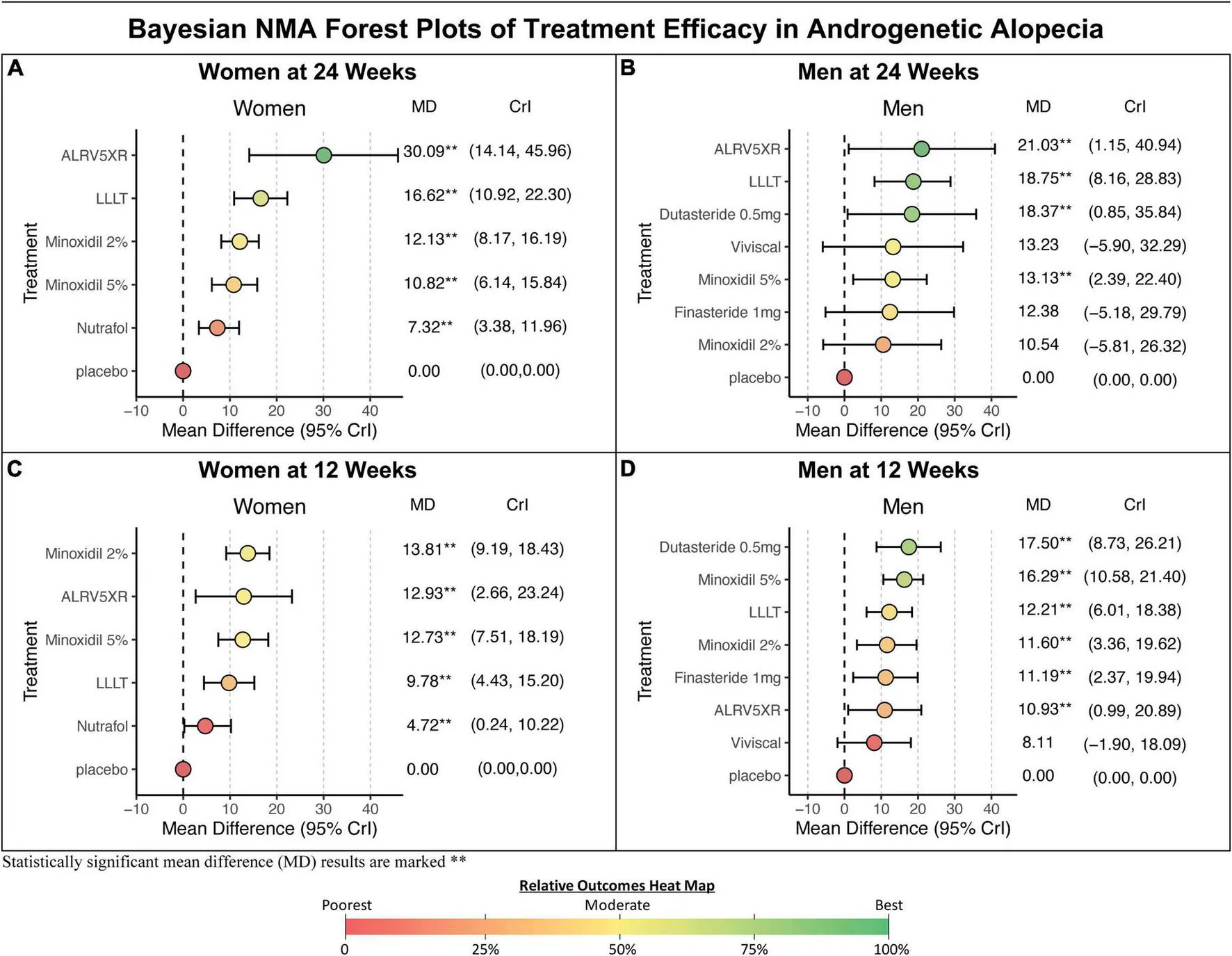
Trials measure several outcomes, including counts and visible coverage. Improvement in one measure does not describe every part of the result.5 Daily effort, adverse effects and cost also affect whether the benefit is worthwhile.
Use the experience in the next recommendation
Bring the original goal, baseline photographs, treatment details and the changes noticed. The assessment should establish whether to correct a delivery problem, improve tolerance, allow more time or choose a different approach.
References
- Feldman PR, Gentile P, Piwko C, et al. Hair regrowth treatment efficacy and resistance in androgenetic alopecia: A systematic review and continuous Bayesian network meta-analysis. Front Med. 2023;9:998623. doi:10.3389/fmed.2022.998623. Return to text ↑
- Van Neste D. Natural scalp hair regression in preclinical stages of male androgenetic alopecia and its reversal by finasteride. Skin Pharmacol Physiol. 2006;19:168-176. Return to text ↑
- Roberts J, Desai N, McCoy J, Goren A. Sulfotransferase activity in plucked hair follicles predicts response to topical minoxidil in the treatment of female androgenetic alopecia. Dermatol Ther. 2014;27:252-254. doi:10.1111/dth.12130. Return to text ↑
- Friedman ES, Friedman PM, Cohen DE, Washenik K. Allergic contact dermatitis to topical minoxidil solution: Etiology and treatment. J Am Acad Dermatol. 2002;46:309-312. doi:10.1067/mjd.2002.119104. Return to text ↑
- Lucky AW, Piacquadio DJ, Ditre CM, et al. A randomized, placebo-controlled trial of 5% and 2% topical minoxidil solutions in the treatment of female pattern hair loss. J Am Acad Dermatol. 2004;50:541-553. doi:10.1016/j.jaad.2003.06.014. Return to text ↑
Author disclosure
Peter R. Feldman is a coauthor of reference 1 and an inventor of ALRV5XR, a treatment included in that analysis.