
Insight 19
Why hair improvement can slow or plateau
Last reviewed
Published
Early improvement can make the next months difficult to judge. Hair may keep improving at a slower rate, hold steady or lose some of the earlier gain. Those courses lead to different decisions.
A single before-and-after comparison leaves this part of the story hidden. Records taken during treatment help establish the course of the response.
The timing of benefit matters
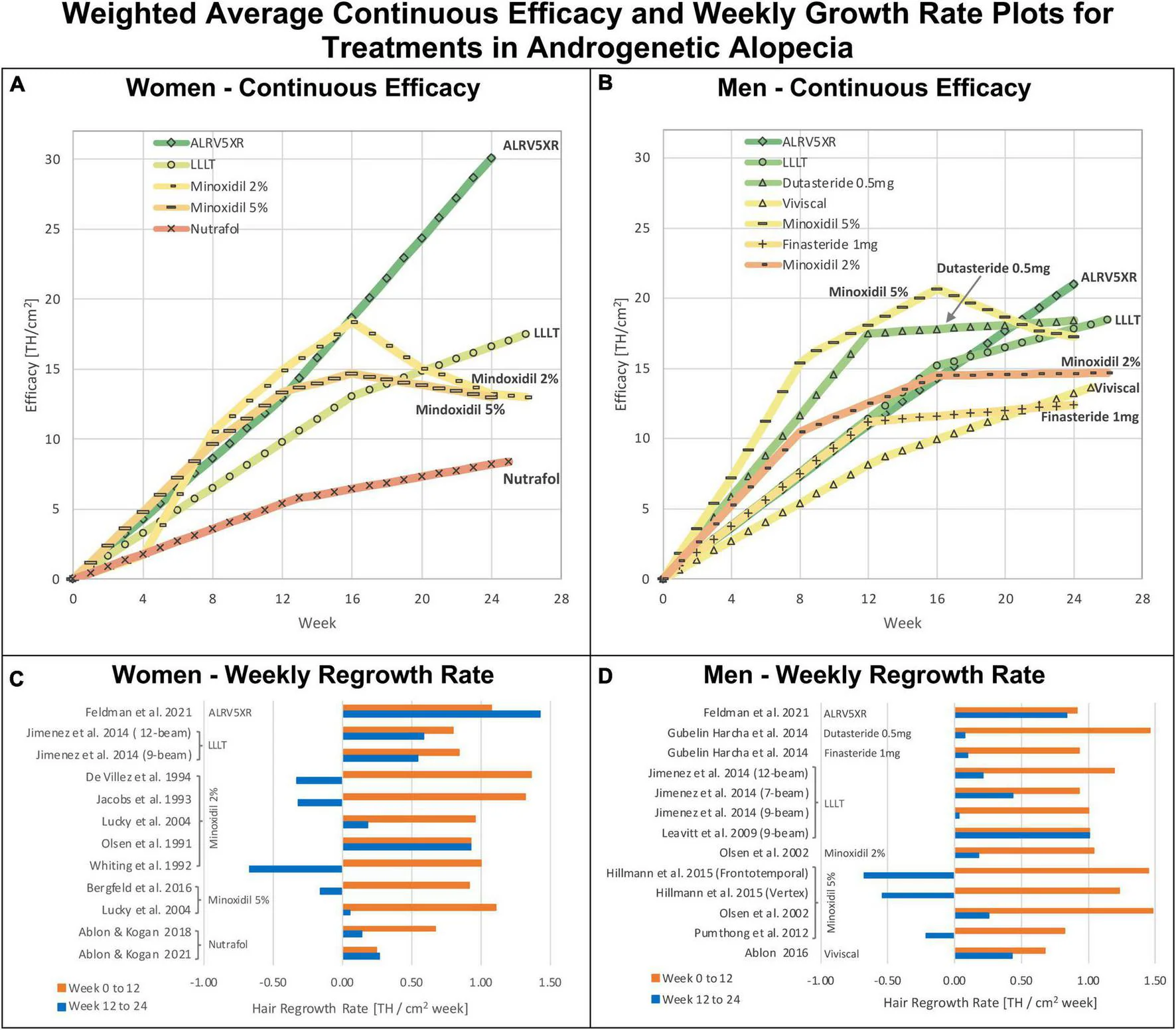
Our published network meta-analysis compared terminal hair regrowth at 12 and 24 weeks. It reported slowing, plateauing or partial loss of earlier gains across several treatments. ALRV5XR showed continued gains during the period examined. The paper described these differences as treatment resistance profiles.1
Here, resistance describes the observed course of regrowth. For each person, the timing and reasons for a plateau need assessment.
Read the time curves with their method
The published curves show the average difference in terminal hair growth between treatment and placebo over time. Weekly estimates between study visits help show how the response changed.1
A slowing curve can still represent added hair. A flat curve describes a stable group result. A downward curve shows loss of some measured improvement. Each needs to be considered alongside treatment burden, symptoms and the original goal.
Slower improvement and loss of an earlier gain lead to different treatment discussions.
Check what changed outside the curve
For an individual, a plateau should prompt review of the starting diagnosis, the treatment actually received and events since treatment began. Interruptions, scalp intolerance and a new shedding trigger can alter the course.
A second condition can also change what the person sees. Recovery at the crown may occur alongside continued change at the front. Overall photographs and measurements of relevant areas help keep those changes separate.
Use uncertainty correctly
The forest plots from the same paper show estimated average treatment effects with 95% credible intervals. The bars show how much uncertainty surrounds each estimate.1
Individual decisions use the study results alongside the person's record, medical circumstances and treatment experience.
Decide what the current benefit is worth
Stable coverage can be useful when preservation was the goal. If fuller coverage was the aim and improvement has stalled, the next recommendation should explain whether to continue, adjust or investigate another contributor.
Bring the earlier photographs and the dates of treatment changes. The useful question is what the course now supports and what finding would justify the next change.
References
- Feldman PR, Gentile P, Piwko C, et al. Hair regrowth treatment efficacy and resistance in androgenetic alopecia: A systematic review and continuous Bayesian network meta-analysis. Front Med. 2023;9:998623. doi:10.3389/fmed.2022.998623. Return to text ↑
Author disclosure
Peter R. Feldman is a coauthor of the cited publication and an inventor of ALRV5XR.