
Insight 15
Why hair treatment studies can give different answers
Last reviewed
Published
One review ranks a treatment near the top. Another gives a different estimate. Both may draw on published trials, yet measure or combine the evidence differently.
That difference matters when a study result becomes a product claim or treatment recommendation. The useful task is to establish what was compared and how closely it matches the decision in front of you.
Start with the outcome
A count of all hairs differs from a count of thicker terminal hairs. A result measured over one scalp area also needs the correct conversion before comparison with another area.
Follow-up duration matters. A 12-week result and a 24-week result can describe different stages of the response. Research methods should make those distinctions visible.1,2
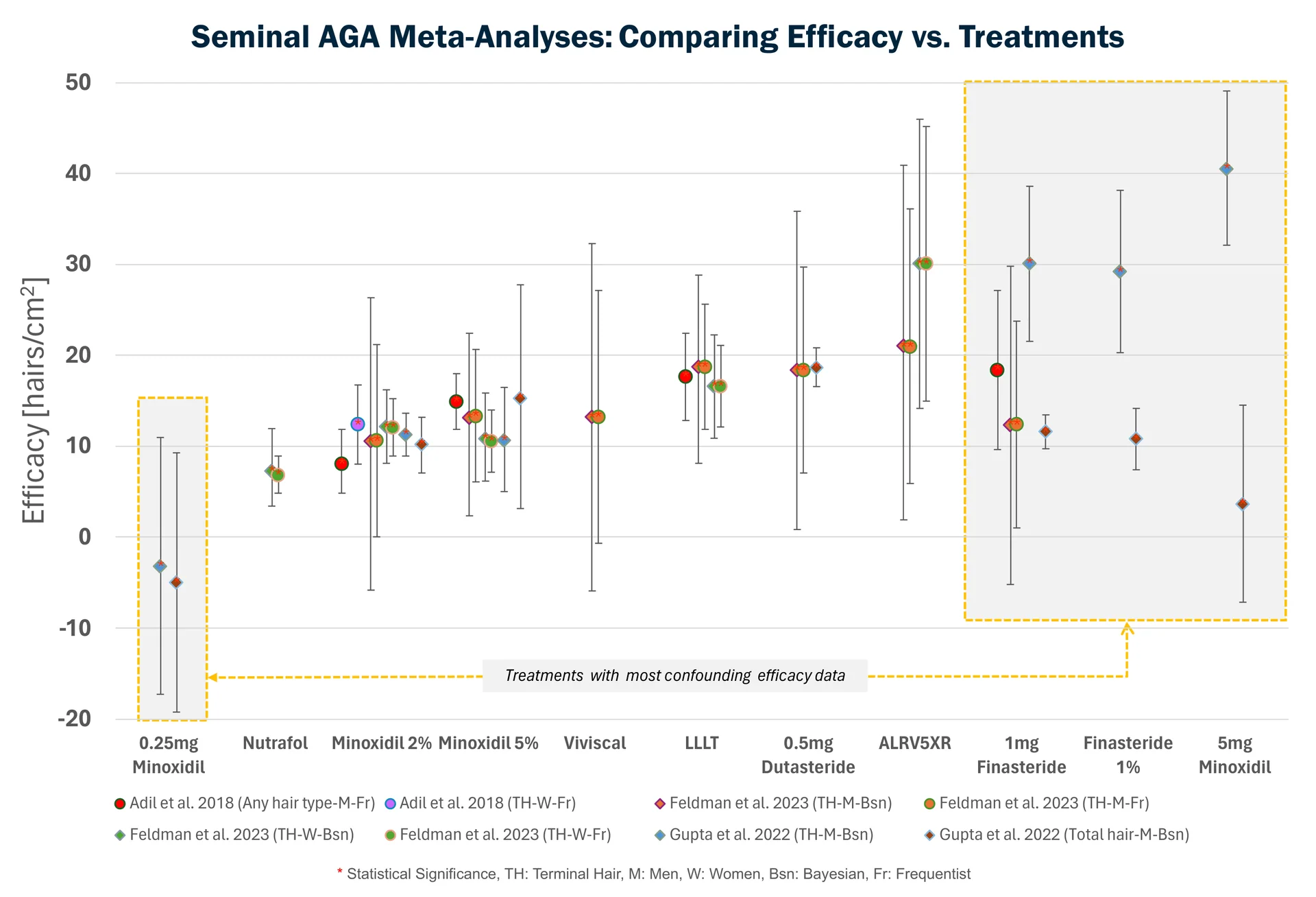
Our poster at the World Hair Research Conference, 2024, Dallas, USA, compared three important meta-analyses from highly regarded medical journals. It identified differences in methods, eligible studies and data extraction that affected the results. The chart shows why a ranking deserves examination before it becomes a recommendation.1
Give the error bars their correct meaning
A standard deviation, or SD, describes the spread of observed results. A confidence interval describes uncertainty around an estimate, such as an average effect. A Bayesian credible interval expresses uncertainty under that analysis model.3,4
A study can estimate an average precisely while people have quite different outcomes. The interval describes the precision of the estimated average; individual outcomes can vary widely.
A treatment ranking is useful only after its outcome, comparison and uncertainty are understood.
Separate appearance from growth
A serum can improve the appearance of fullness or contain an active treatment. A shampoo may reduce scale or help hair handling. A study of hair counts answers another question.
The product format alone cannot establish the outcome. US regulatory categories also depend on intended use and claims.5 The finished preparation, amount used and population studied need to match the proposed claim.
Small studies can be informative. Their design, measurements, consistency and follow-up determine how much they establish. A large percentage improvement still needs its starting number and comparison.
Use the evidence in a personal decision
A systematic review organizes studies. A meta-analysis combines results statistically. The quality of the underlying studies and the populations included shape the result.
Before choosing a treatment, identify the condition studied, the outcome achieved and the effort required. Evidence from the original trials helps resolve questions left by a summary.
Bring the claim or paper when seeking advice. I use it with the examination and treatment history to recommend where the option fits and how its benefit should be assessed.
References
- Feldman P, Van Neste D, Horwood N, Fiebig K, Messenger A, Donovan J. Androgenetic Alopecia Treatment Evidence Varies Widely in Meta-Analyses: A Call for Consensus in AGA Clinical Research Methods. Poster P206. 13th World Congress for Hair Research; Dallas; 2024. Return to text ↑
- Van Neste D. Assessment of hair loss: Clinical relevance of hair growth evaluation methods. Clin Exp Dermatol. 2002;27:358-365. doi:10.1046/j.1365-2230.2002.01003.x. Return to text ↑
- Cochrane. Handbook for Systematic Reviews of Interventions. Chapter 6 Choosing effect measures and computing estimates of effect. https://www.cochrane.org/authors/handbooks-and-manuals/handbook/current/chapter-06 Return to text ↑
- Cochrane. Handbook for Systematic Reviews of Interventions. Chapter 10 Analysing data and undertaking meta-analyses. https://www.cochrane.org/authors/handbooks-and-manuals/handbook/current/chapter-10 Return to text ↑
- US Food and Drug Administration. Is It a Cosmetic a Drug or Both Or Is It Soap. https://www.fda.gov/cosmetics/cosmetics-laws-regulations/it-cosmetic-drug-or-both-or-it-soap Return to text ↑
Author disclosure
Peter R. Feldman is a coauthor of the poster and an inventor of ALRV5XR. The poster includes his research alongside other analyses. It is a conference report; the underlying publications remain the sources for individual study results.